Chapter 2 of 7 · Headline Prediction #1
Chapter 2: Compressing Frontier Intelligence — Algorithmic Efficiency, Distillation, and the 2030 Parity Claim
Software and compression foundation for Prediction #1: “By 2030, local AIs will be as powerful as big data centers.”
Thesis
By 2030, local AIs will be as powerful as big data centers—operationally, a mass-market consumer device (≤60 W laptop or ≤10 W flagship phone) will run open-weight models matching or exceeding 2025–2026 frontier cloud models at interactive speeds, and matching contemporaneous 2030 cloud APIs on the large majority of real-world user queries. This follows from compounding algorithmic efficiency (~0.45 OOMs/yr), reasoning distillation, low-bit quantization, and sparse MoE routing—while candidly acknowledging that a handheld device will not match a contemporaneous multi-gigawatt 2030 cluster on unbounded parallel search.
The concession that clarifies the mechanism. Local AI exists because of the big centralized data centers. Frontier training runs in centralized clusters—scaling at 4–5× per year [S04]src—produced the teacher models and open-weight bases. Four software mechanisms then moved that capability down into consumer envelopes: knowledge distillation (compressing ensembles or large teacher models into deployable smaller networks, Hinton et al. [S38]src, and reasoning-trace distillation analyzed by Epoch AI [S21]src), post-training quantization (GPTQ compressing 175B models to 3–4 bits with negligible degradation and down to 2-bit/ternary [S39]src), parameter-efficient quantized fine-tuning (QLoRA fitting 65B adaptation on one 48 GB GPU [S40]src), and open-weight releases beginning with LLaMA [S41]src and now trailing closed SOTA by roughly four months on public benchmarks [S02]src.
The local layer is parasitic on the centralized layer for its capability, but independent of it in operation. Our argument is that this concession does not rescue standalone centralized-API economics: software compression is precisely what lets the small device harvest the output of centralized training without paying recurring API rents (see also Interlude: What the Big Thing Builds). For an external overview of AI benchmark scores relative to human performance, see Our World in Data's non-redistributable capability chart (link only, not embedded due to data licence) [S64]src.
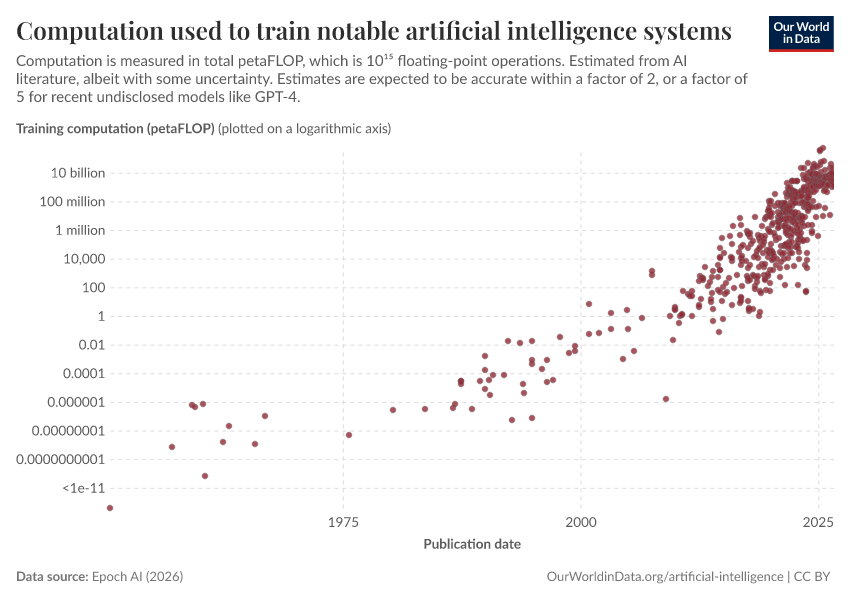
Plotted milestone table (536 models from Epoch AI plotted in full above)
| Model | Publication date | Training compute (petaFLOP) | Source |
|---|---|---|---|
| AlexNet | 2012-09-30 | 470 | Epoch AI / OWID |
| wave2vec 2.0 LARGE | 2020-10-22 | 3,870,720 | Epoch AI / OWID |
| xTrimoPGLM -100B | 2023-07-06 | 620,000,000 | Epoch AI / OWID |
| A.X K2 | 2026-07-29 | 1,800,000,000 | Epoch AI / OWID |
data/owid-ai-training-computation.csv). Licence: CC BY 4.0. Credit: Epoch AI (2026), via Our World in Data; rendered with vendored D3 v7.9.0 (ISC License).Operational framing note (what Prediction #1 claims and does not claim):
- Primary operational form (high confidence): By Q4 2030, a consumer laptop (≤60 W, ≤64 GB unified memory, ≤$2,500) locally runs an open-weight model matching median 2026 frontier cloud quality (ECI ≥ 158 / GPQA-Diamond ≥ 85%, GPT-5.5 / Claude Opus 4.7 class [S02]src [S24]src) at ≥25 tok/s; and a flagship phone (≤10 W sustained, ≤24 GB RAM) locally runs 2025 frontier cloud quality (ECI ≥ 147 / o3 / Claude Sonnet 4.5 class [S02]src) at ≥15 tok/s.
- Stronger variant (moving-frontier everyday parity, medium confidence): By Q4 2030, a ≤$2,500 consumer machine matches or ties the contemporaneous 2030 top-3 cloud APIs on ≥90% of real-world single- and multi-turn everyday knowledge/coding queries (extending arXiv:2511.07885's 88.7% single-turn baseline [S12]src).
- Explicit boundary: We do not claim a 10 W phone will match a contemporaneous 2030 4–16 GW data center [S05]src on frontier scientific discovery or 10,000-rollout parallel search (see Claims We Deliberately Do Not Make).
Dated, Quantified, Falsifiable Predictions
- P04 (Laptop Matches 2026 Cloud Frontier): By 2030-12-31, an open-weight model fitting inside ≤48 GB RAM (running locally on a ≤$2,500, ≤60 W laptop at ≥25 tok/s) will score ≥158 on Epoch's ECI (or ≥85% on GPQA-Diamond and ≥85% on SWE-bench Verified, matching Q2 2026 frontier closed models GPT-5.5 / Claude Opus 4.7 [S02]src [S22]src [S24]src) (resolution: Epoch AI ECI leaderboard + reproducible local
llama.cpp/MLX run). Confidence: 80%. - P05 (Smartphone Matches 2025 Cloud Frontier): By 2030-12-31, an open-weight model fitting inside ≤12 GB usable app memory (running locally on a flagship smartphone at ≥15 tok/s) will score ≥147 on Epoch's ECI (matching 2025 frontier reasoning models o3 / Claude Sonnet 4.5 [S02]src) (resolution: Epoch AI ECI + reproducible on-device mobile benchmark). Confidence: 65%.
- P06 (Moving-Frontier Everyday Parity): By 2030-12-31, independent evaluation on a 100k+ real-world query suite (comparable to arXiv:2511.07885 [S12]src) will find that local models (≤32B active parameters on ≤$2,500 consumer hardware) achieve ≥90% win/tie parity against contemporaneous 2030 frontier cloud models on single-turn and standard multi-turn knowledge/coding tasks, while maintaining ≤12 months lag behind absolute closed SOTA on consumer hardware (extending Epoch's 6–12 mo finding [S24]src). Confidence: 55%.
Supporting Trends, Data & Extrapolation Arithmetic
-
Algorithmic efficiency OOMs [S03]src: Epoch AI (Ho et al., 2024) measured that pre-training compute required for a fixed language-model performance threshold halved approximately every 8 months (95% CI: 5 to 14 months) from 2012–2023—equivalent to
2^(12/8) = 2.83×/year(0.45 OOMs/yr central; 0.26–0.72 OOMs/yr CI). -
Empirical compression of frontier-class models onto consumer hardware (2023–2026) [S24]src: Epoch AI's Consumer GPU Model Gap (Aug 2025) found that a single <$2,500 consumer GPU runs models matching the absolute cloud frontier from 6 to 12 months prior [S24]src. Its benchmark table records rapid parameter compression:
- GPT-4 (Jun 2023, ~1.8T params): GPQA-Diamond 31.0 → exceeded in 10 months by Phi-3 Medium 14B (Apr 2024, 33.0) and nearly doubled in 26 months by Hunyuan 4.2B (Aug 2025, 61.1)—a >400× reduction in parameter count while roughly doubling PhD-science accuracy.
- GPT-4o (May 2024): GPQA-Diamond 49.0, MMLU-Pro 74.0 → matched/beaten in 12 months by DeepSeek-R1-0528-Qwen3-8B (8.2B params) (May 2025, GPQA-D 61.0, MMLU-Pro 74.0).
- o1 (Dec 2024): GPQA-Diamond 75.0, MMLU-Pro 84.0 → nearly matched in 7 months by EXAONE 4.0 32B (Jul 2025, GPQA-D 74.0, MMLU-Pro 82.0) and Qwen3 30B-A3B (Jul 2025, 3B active params, GPQA-D 71.0, MMLU-Pro 81.0, LMArena 1,382 vs o1's 1,398).
- Inference price collapse as an efficiency proxy [S01]src [S22]src: Epoch AI (Sep 2026) shows fixed-capability inference cost fell 47% per quarter (13×/yr) since 2023—and 725× in under 18 months on GPQA-Diamond 75% (o3 at $0.30/question in Jan 2025 → GPT-5.6 Luna at $0.0004/question in 2026) [S01]src. Stanford AI Index 2025 independently documented a >280× drop in GPT-3.5-level inference cost from Nov 2022 to Oct 2024 [S22]src.
-
Real-world query coverage & Intelligence per Watt (IPW) [S12]src [S15]src: Across 1M real-world single-turn chat and reasoning queries, local LMs (≤20B active params) answered 88.7% successfully; from 2023–2025, IPW improved 5.3× and locally-serviceable query coverage rose from 23.2% to 71.3%, while local accelerators retained ≥1.4× uncaptured IPW headroom relative to cloud hardware running identical weights [S12]src. In production, Apple ships a ~3B on-device model using 2-bit QAT and KV-cache sharing [S15]src, while Quenderin's catalog tracks ternary 1-bit/1.58-bit experimental checkpoints (
Bonsai 2 4Bat 0.95 GB,Bonsai 2 27Bat 5.95 GB,shared/model-catalog.json:17-54). -
Explicit 2026 → 2030 OOM decomposition (our extrapolation, 4.0 years):
- Algorithmic efficiency / distillation (conservative 14-mo halving to central 8-mo halving [S03]src):
2^(48/14) = 10.8×(1.03 OOMs) to2^(48/8) = 64×(1.81 OOMs). - Local hardware bandwidth + capacity + IPW optimization (+17.3%/yr bandwidth from Ch. 1 →
1.89×+ closing the1.4×local IPW gap [S12]src):1.89 × 1.4 ≈ 2.65×(0.42 OOMs). - Precision & architectural sparsity (4-bit dense → 2-bit QAT/ternary + sparse MoE active-param ratio): conservative
2×to3×(0.30–0.48 OOMs). - Total local effective capability gain (2026 → 2030): ~1.75 to 2.71 OOMs (~56× to ~510×). Because 2026 consumer hardware sits 6–12 months (roughly 8–14 ECI points [S02]src [S23]src [S24]src) behind closed cloud SOTA, 1.75–2.71 OOMs of local gain absorbs 2025–2026 frontier models onto 2030 laptops and phones with margin.
- Algorithmic efficiency / distillation (conservative 14-mo halving to central 8-mo halving [S03]src):
Plotted data table: cited capability-adjusted inference price declines (S01, S22)
| Benchmark / regime | Period | Cited price decline | Source |
|---|---|---|---|
| 2 yrs post-SOTA decay | Annual rate | 32%/qtr (4.7×/yr) | Epoch AI [S01] |
| Overall fixed capability | Annual rate (since 2023) | 47%/qtr (13×/yr) | Epoch AI [S01] |
| Fresh SOTA debut decay | Annual rate | 66%/qtr (75×/yr) | Epoch AI [S01] |
| GPT-3.5-level inference | Nov 2022–Oct 2024 (23 mo) | >280× drop | Stanford HAI [S22] |
| GPQA Diamond 75% (o3 → GPT-5.6 Luna) | <18 months (2025–2026) | 725× ($0.30 → $0.0004/q) | Epoch AI [S01] |
| Claim / metric | Cited number | Source |
|---|---|---|
| Pre-training algorithmic compute halving time (2012–2023) | ~8 months (95% CI: 5–14 months) | [S03] |
| Consumer GPU (<$2,500) lag behind absolute cloud frontier | 6–12 months | [S24] |
| Local LM (≤20B active) single-turn real-world query success | 88.7% (coverage 23.2% → 71.3%; IPW +5.3×) | [S12] |
| GPTQ post-training quantization | 175B model to 3–4 bit in ~4 GPU hrs; 2-bit/ternary viable | [S39] |
| Apple production on-device foundation model | ~3B parameters, 2-bit QAT + KV-cache sharing | [S15] |
Steelman Counterargument & Rebuttal
- Steelman: Two strong objections challenge this trajectory. First, benchmark optimization (“benchmaxxing”): both Epoch AI [S01]src [S24]src and Artificial Analysis [S14]src (per ActuIA's secondary summary) warn that small open models are frequently tuned for public test sets, so real-world lag exceeds the 6–12 month benchmark lag. Second, RL and test-time compute scaling: Epoch AI documents [S21]src [S23]src that reasoning models lifted ECI progress from 6 to 14 points/year by spending far more variable inference tokens per task. If 2027–2030 gains depend on extended chain-of-thought rollouts and multi-step tool loops, small local devices encounter thermal and latency walls even when weights fit in RAM.
- Rebuttal: Both objections are valid and explain why we exclude claims that phones will beat multi-GW clusters on parallel search. Neither prevents 2025–2026 cloud parity or everyday query coverage. As Epoch AI's Jean-Stanislas Denain notes [S21]src, reasoning traces generated by large RL teachers are directly distillable into smaller student models, and successive model generations reach equivalent accuracy with shorter chains of thought alongside speculative decoding and KV-cache compression. Even if benchmark overfitting doubles real-world lag from 6–12 months to 12–24 months, a 2030 consumer device still reaches 2026–2028 frontier cloud quality.
Falsifier
This chapter's parity claim is falsified if, by 2029-12-31, no open-weight model fitting in ≤48 GB RAM scores ≥152 on ECI (or ≥80% on uncontaminated private reasoning/coding suites such as Artificial Analysis's secret-test index), OR if Epoch AI's consumer-hardware lag widens permanently beyond 24 months between 2026 and 2029.